Looking for a French course for children that follows a real plan? At Cmonprof.com, every live lesson belongs to a written curriculum that takes a child from a first “bonjour” to confident, independent French. This page shows you the whole path: the four levels, what your child will be able to do at each stage, what happens inside a lesson, and what your child can use between two lessons.
The curriculum at a glance
- For children aged 5 to 16, from complete beginners to advanced learners
- 4 levels aligned with the CEFR: A1, A2, B1 and B2
- Each level divided into themed units and short, focused lessons
- Individual live lessons with a native French teacher
- Course pages, revision cards and online practice between lessons, on TestFLE
- Personal feedback from the teacher after every lesson
Why a French course for children needs a real curriculum
Many online lessons for kids are pleasant, but they go nowhere. One week the child learns animals, the next week a song, and after a year nobody can say what has really been learned. Children feel it too, and motivation fades.
A serious course works the other way round. Each lesson prepares the next one. Words come back several times before they are considered known. Grammar arrives when the child needs it to say something, not before.
A written curriculum also protects your investment. If your child changes teacher, moves to another country or takes a break, the path is still there, and the next lesson starts exactly where the last one stopped.
Who is this course designed for?
Our French course for children welcomes learners aged 5 to 16. Some have never heard a word of French. Others speak it at home with one parent, or learn it at school and need more confidence. The curriculum is the same for everyone, but the starting point and the pace are not.
That is why each child begins at the right place. A five-year-old who cannot read yet does not learn like a teenager preparing for an exam. The teacher adapts the pace, the activities and the vocabulary to the age of the child, while keeping the same clear objectives for each level.
Families join us from many countries and time zones. Most parents do not speak French themselves, and they do not need to. Everything you need to follow your child’s progress is explained in English.
How the curriculum is built: levels, units and lessons
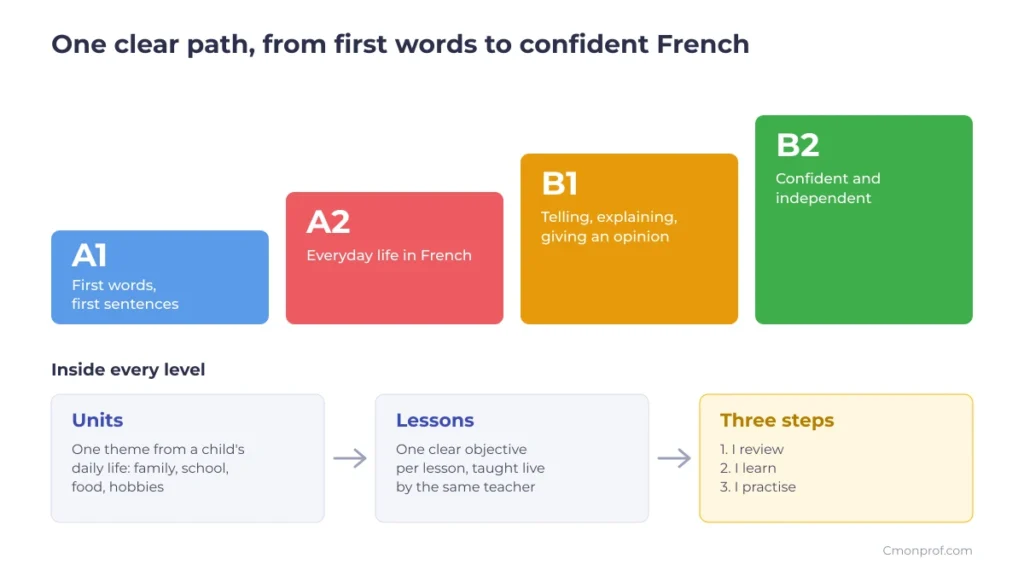
A good French course for children needs more than nice lessons. It needs an order. Our curriculum follows the Common European Framework of Reference for Languages (CEFR), the international scale used by schools and examiners around the world. You can read the official description of the CEFR levels on the Council of Europe website.
The path is divided into four levels: A1, A2, B1 and B2. Each level is split into two steps (A1.1 and A1.2, for example), because small steps are easier to see and more motivating for a child.
Each level is organised in the same way:
- Units built around a theme from a child’s daily life: family, school, food, hobbies
- Lessons inside each unit, each with one clear objective
- Review moments built into every lesson, so that nothing learned is left behind
This regular structure helps children feel safe. They know how a lesson starts, how it ends and what comes next. It also helps parents: at any moment, you can see exactly where your child is on the path.
The whole programme is designed and written by Christophe, the founder of Cmonprof.com, who has taught French to children for more than a decade. It is created for young learners from the first page, not adapted from a method for adults, and it is refined year after year with what works in real lessons.
What your child will be able to do at each level
The CEFR describes each level with “can do” statements. Here is what they mean, in simple words, for a child who follows the path with us.
Level A1: first words and first sentences
Level A1 is for true beginners. Your child learns to say hello, introduce themselves, count, name colours, and talk about family, pets, school and food. By the end of A1, your child can:
- understand simple instructions and short, slow sentences
- answer basic questions about themselves
- read and write short words and simple sentences
- take part in a very simple conversation with a patient adult
Level A2: everyday life in French
At A2, French becomes a tool for daily life. Your child describes their day, their home and their hobbies, talks about what they like and dislike, and starts telling what happened yesterday or what will happen tomorrow. By the end of A2, your child can:
- follow a short story or a simple cartoon dialogue
- ask and answer questions on familiar topics
- write a short message or a few connected sentences
- manage simple, everyday situations in French
Level B1: telling, explaining and giving an opinion
B1 is the level of independence. Your child tells a story, explains a choice, describes a dream or a project, and gives a simple opinion with reasons. Grammar becomes richer, with past and future tenses used together. By the end of B1, your child can:
- understand the main points of clear speech on familiar subjects
- take part in a conversation without preparing every sentence
- read short texts written for young readers
- write a simple, connected text about a personal experience
Level B2: confident and independent
At B2, your child uses French with ease. They follow longer explanations, discuss ideas, compare points of view and defend an opinion. By the end of B2, your child can:
- understand detailed speech and most texts on topics they know
- speak fluently enough to talk naturally with a French speaker
- write clear, organised texts and explain advantages and disadvantages
- study other subjects in French with growing confidence
Not sure where your child stands today, or which level fits? Try our free quick French level test for children. It takes a few minutes and gives an immediate first idea.
Inside a lesson: review, learn, practise
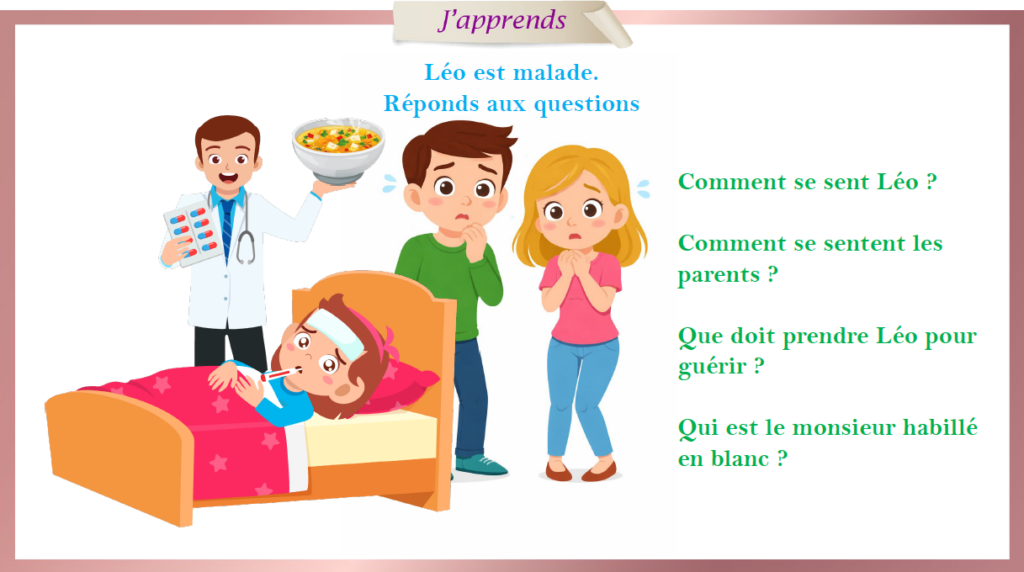
Every lesson follows the same three steps. Children recognise them quickly, and that routine gives them confidence.
- I review (“Je révise”). The lesson opens with a short return to what was learned before. Memory needs repetition, especially at a young age.
- I learn (“J’apprends”). The teacher introduces one new point: a set of words, a sound, a structure or a verb. One objective per lesson, never five.
- I practise (“Je m’entraîne”). The child uses the new point straight away, through games, speaking activities and short exercises.
Lessons take place live, as a rule one teacher with one child, in an interactive online classroom called ClassIn. The teacher and the child share the same board: they write, draw, move pictures and play on it together.
Children also meet the same characters from lesson to lesson: Léo and Isabelle, a brother and sister, and their friends Yang and Tom. Following familiar characters makes dialogues easier to understand and gives children a reason to come back.
For beginners, the teacher starts with simple words, gestures and mime, then builds up step by step. English can be used for a short explanation when a child really needs it.
Between lessons: course pages, interactive activities and online practice
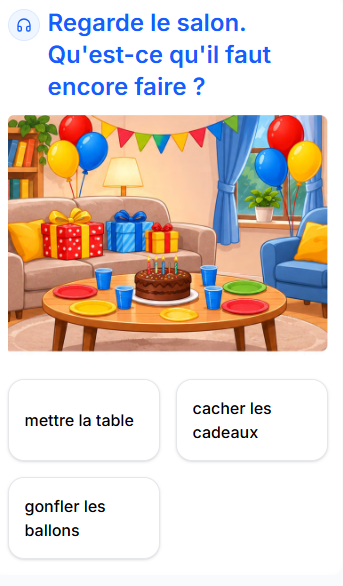
One lesson a week is not enough if nothing happens in between. This is where our course goes further than a simple video call. Every student receives a personal account on TestFLE, the learning platform created by Cmonprof.com, at no extra cost.
Course pages in the library
After a lesson, the teacher opens the matching course page in your child’s online library. Your child can read it again at home, at their own speed. Pages are opened one by one, as lessons are completed, so a child is never lost in content that is too hard.
Next to each document, your child can write personal notes. They are saved automatically, and the teacher can read them to see what was understood.
Interactive activities
Some learning is better done by touching and playing. In the library, your child will find:
- revision cards that flip over: a picture and its word, a verb and its conjugation, a sentence and its rule
- pictures to discover: the child touches part of an image to see the French word and hear it pronounced
These activities are not marked. They are there to help a child remember, without pressure.
Online practice
The practice area contains short quizzes prepared by the teacher on what was studied in class. Each quiz is marked out of 20 and comes with a correction, so your child understands every mistake. Older children can also write a short text online. The teacher corrects it by hand and can ask the child to improve it.
Laura, the French chatbot
Finally, every student can chat in French at any time with Laura, our French learning chatbot for kids. Laura adapts to the level of the child and never gets tired of repeating.
How you follow your child’s progress
Parents often ask the same question: “Is my child really making progress?” You should never have to guess. Several simple signs show you where your child stands.
- After every lesson, the teacher leaves stars and a short written comment. You know what was studied, what went well and what needs more work.
- In the practice area, each quiz gives a mark out of 20. Week after week, you can see whether a point is understood or needs another look.
- In the library, the list of opened course pages shows how far your child has travelled: which level, which unit, which lesson.
- In the notes, your child’s own words show what they remember, and the teacher reads them too.
Lessons are also recorded. For three months, your child can watch a lesson again to hear an explanation one more time. Recordings stay private: they are only available to your child, the teacher and the school.
Because every lesson has its place in the curriculum, progress is easy to name. “My child is in level A1, unit 4, lesson 6” says much more than “my child has been learning French for a year”.
The teachers who bring the curriculum to life
A curriculum is only as good as the person who teaches it. Our teachers are native French speakers with real experience of teaching children. They know how to keep a six-year-old focused, and how to speak to a teenager without talking down to them.
Your child keeps the same teacher from one level to the next. This continuity matters. The teacher knows what your child has learned, what still needs work and what makes them smile. Over time, a real relationship of trust is built, and children speak more freely with an adult they know well.
This is also what makes a French course for children different from an app: a real person notices when your child is tired, proud or worried, and adjusts the lesson.
Some children are shy. Some cannot sit still. Some have been told that they are “not good at languages”. We welcome all of them. A patient teacher and a clear path change a lot.
How to start
Getting started takes four simple steps.
- Book a free trial lesson. The first 30-minute lesson is free, with no credit card and no commitment. Fill in the form on our plans and pricing page.
- Meet the teacher. During the trial, the teacher gets to know your child, checks their level and shows them how the online classroom works.
- Receive your feedback. After the trial, the teacher sends you a complete written feedback: your child’s level, their strengths, and a recommendation for the length and the number of lessons per week.
- Follow the path. You choose the rhythm that suits your family, and your child starts at the right unit of the curriculum.
You only need a computer or a tablet, a stable internet connection, a webcam and a headset with a microphone.
French course for children: frequently asked questions
At what age can a child start?
Children can start from age 5. At that age, lessons rely on pictures, songs, games and movement, and reading comes later. The course is designed for learners up to 16. Older children follow the same levels with topics and documents suited to their age.
Is the course suitable for complete beginners?
Yes. Level A1 was written for children who start from zero. The teacher speaks slowly, uses pictures and gestures, and repeats as often as needed. When a child is really stuck, a few words of English help them move on.
How many lessons per week should my child take?
There is no single answer, because every child is different. After the free trial, the teacher who met your child sends you a complete feedback with a recommendation: how long each lesson should be and how many lessons per week, depending on the age, the level and the attention span of your child. The final choice is always yours.
How long does it take to complete a level?
It depends on the age of the child, the number of lessons per week and the work done between lessons. A child who uses the course pages and the online practice every week moves faster than a child who only attends the live lesson. Your teacher can give you a realistic estimate after the first few lessons.
Can brothers and sisters learn together?
Yes. Lessons are normally individual, but siblings with a similar level and maturity can share the same lesson, at no extra cost, with a maximum of two children. The teacher tells you after the trial whether learning together is a good idea for them.
Can my child take lessons with a friend?
On request, we can organise duo lessons for two students who already know each other. Each child connects from their own account and their own computer. Prices for duo lessons are available on request.
My child already speaks French at home. Is this course still useful?
Yes. Many children who speak French with a parent understand everything but struggle to read, write or use correct grammar. The teacher identifies these gaps during the trial lesson and starts the curriculum at the right unit for your child. Reading, spelling and grammar then catch up with speaking.
How can I follow my child’s progress if I do not speak French?
You do not need to speak French. The teacher’s comments, the feedback after the trial and our messages to parents are written in English. You can also find advice for families on our blog and answers to practical questions in our FAQ.
Ready to see the curriculum in action?
The best way to judge a French course for children is to watch your own child in a lesson. It all starts with a free 30-minute trial: meet the teacher and see how your child reacts. If the lesson goes well, you will know exactly which unit comes next.